
In today’s business world, meeting customer expectations, protecting the environment, and ensuring workplace safety are not just good practices—they’re essential. That’s where ISO standards come in. Among the most widely adopted are ISO 9001:2015 Quality Management Systems (QMS), ISO 14001:2015 Environmental Management Systems (EMS), and ISO 45001:2018 Occupational Health and Safety Management Systems (OHSMS). But what do these standards involve, and what sets them apart? Here’s a clear, practical breakdown.
Looking to get ISO 9001, ISO 14001, or ISO 45001 certification? UCS provides accredited certification services with a fast, straightforward process.
Get Free Certification Quote Today
What is ISO 9001?
Definition and Purpose
ISO 9001:2015 is the international standard for Quality Management Systems (QMS). It ensures that organizations consistently deliver products and services that meet customer and regulatory requirements.
Key Requirements
- Strong customer focus
- Leadership commitment
- Process approach
- Continual improvement
Benefits for Businesses
- Improved customer satisfaction
- Streamlined processes
- Increased efficiency and reduced waste
- Better market reputation
What is ISO 14001?
Definition and Purpose
ISO 14001:2015 is the international standard for Environmental Management Systems (EMS). It provides a framework for organizations to manage their environmental responsibilities.
Key Requirements
- Identifying environmental aspects and impacts
- Legal compliance
- Pollution prevention
- Sustainable resource use
Benefits for Businesses
- Reduced environmental footprint
- Lower energy and resource costs
- Compliance with environmental laws
- Improved public image
What is ISO 45001?
Definition and Purpose
ISO 45001:2018 is the international standard for Occupational Health and Safety Management Systems (OHSMS). It aims to prevent workplace injuries and illnesses.
Key Requirements
- Hazard identification and risk assessment
- Compliance with safety regulations
- Employee participation
- Incident investigation and prevention
Benefits for Businesses
- Safer working environments
- Reduced accident rates
- Lower insurance premiums
- Better staff morale and retention
Core Differences Between ISO 9001, ISO 14001, and ISO 45001
Main Focus Areas
- Quality management certification: Quality and customer satisfaction
- Environmental management standard: Environmental impact and sustainability
- OHSMS: Health and safety of workers
Target Audience
- Quality management certification: Customers, regulatory bodies
- Environmental management standard: Environmental agencies, communities
- OHSMS: Employees, safety regulators
| Standard | Main Focus Areas | Primary Goal | Key Areas Evaluated in Certification |
| ISO 9001:2015 Quality Management System | Quality and customer satisfaction | Deliver consistent, high-quality products and services | Quality management processes, customer satisfaction monitoring, continual improvement evidence |
| ISO 14001:2015 Environmental Management System | Environmental impact and sustainability | Promote responsible environmental management | Environmental aspects register, legal compliance records, sustainability initiatives |
| ISO 45001:2018 Occupational Health and Safety Management System | Health and safety of workers | Maintain a safe and healthy workplace | Risk assessments, incident records, employee safety training documentation |
Certification Process Differences
While the audit process is similar, the documentation, focus areas, and legal requirements differ for each standard.
Similarities Between the three frameworks
High-Level Structure (HLS)
All three follow the same structure, making integration easier.
PDCA Cycle
Plan-Do-Check-Act ensures continual improvement.
Risk-Based Thinking
Proactively managing risks and opportunities is central to all three standards.
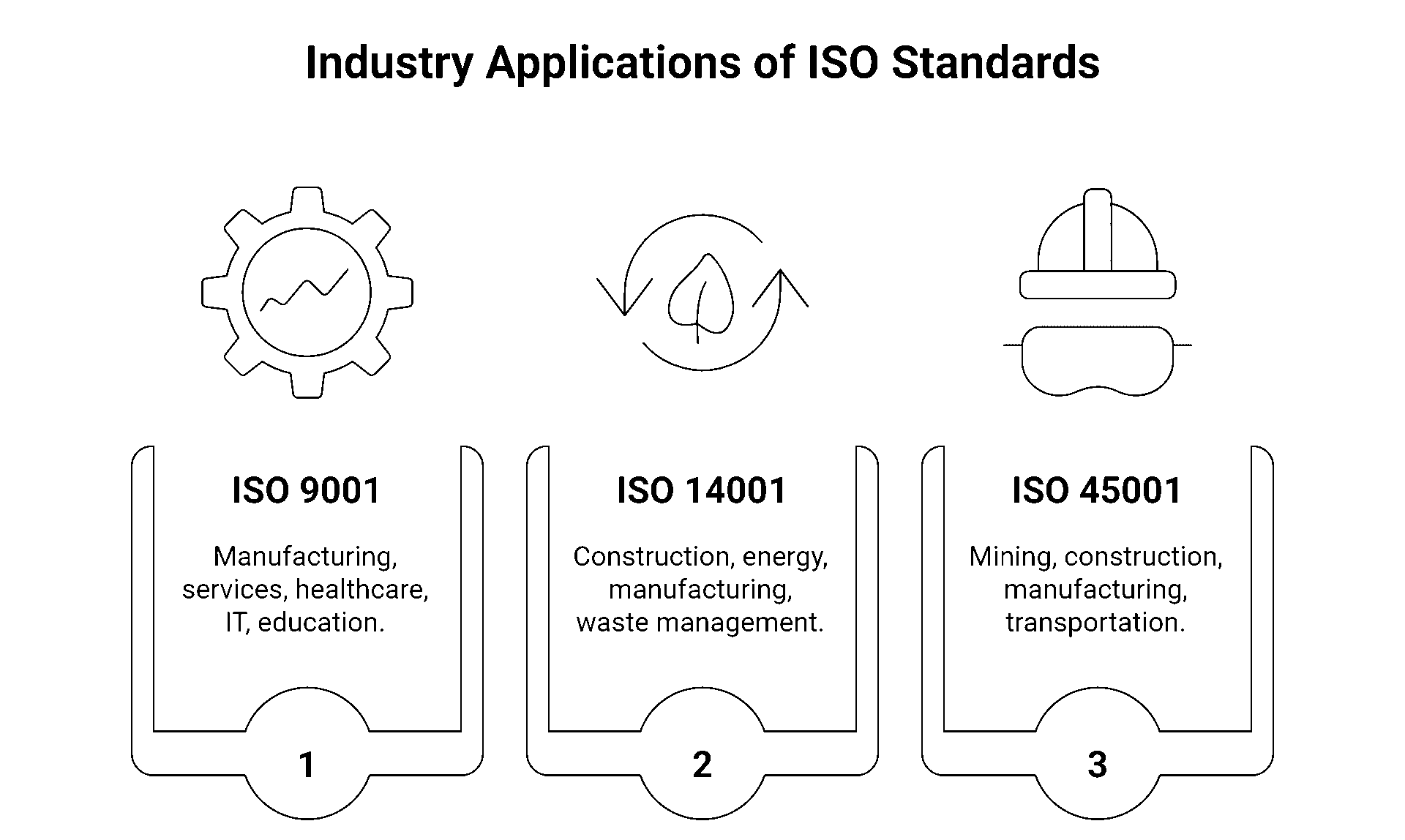
Industry Applications of Each Standard
Where qMS is Most Used
Manufacturing, services, healthcare, IT, education.
Where EMS is Most Used
Construction, energy, manufacturing, waste management.
Where OHSMS is Most Used
Mining, construction, manufacturing, transportation.
Single Standard vs Multiple Certifications
If quality is your main focus, start with QMS. For environmental concerns, go for EMS. If safety is critical, OHSMS is your go-to—or integrate them for maximum benefits.
Factors to Consider
- Industry requirements
- Customer expectations
- Legal obligations
Integrating all three certifications
Benefits of Integration
- Reduced duplication of work
- Easier management and audits
- Lower costs over time
Cost and Timeframe for Certification
Factors Affecting Cost
- Company size
- Scope of certification
- Audit requirements
Typical Certification Timelines
Usually 7–10 days depending on readiness and resources.
Certification with UCS – How It Works
Once you’ve selected the ISO standard(s) that align with your business goals, UCS follows a straightforward, accredited process to get you certified:
- Application – Submit your certification request to start the process.
- Certification Agreement – We share the agreement for your review and signature.
- Stage 1 Audit – Review of your documentation and readiness for certification.
- Stage 1 Audit Report – Receive findings and observations.
- Stage 2 Audit – Assessment of your system’s implementation and effectiveness.
- Final Report & Certification – Address any findings, then UCS issues your certification.
Start your certification journey today. Request a Free Quote
Common Challenges and How to Overcome Them
Resource Allocation
Assign dedicated teams to coordinate ISO activities.
Employee Engagement
Involve staff in decision-making to gain buy-in.
Maintaining Compliance
Regular audits and refresher training help sustain certification.
The Future of ISO Standards
Digital Transformation in ISO Audits
Remote audits and digital tools are becoming standard.
Sustainability Trends
Expect more focus on climate change and social responsibility.
Conclusion
ISO 9001: Quality Management Systems, ISO 14001: Environmental Management Systems, and ISO 45001: Occupational Health and Safety Management Systems each address a unique but equally important aspect of business success quality, environment, and safety. While they can be applied separately, integrating them can bring greater efficiency and long-term benefits.
Get certified with UCS Show your commitment to quality, sustainability, and safety. Request a Quote.
Learn more about ISO standards Visit the International Organization for Standardization (ISO) official website for complete details on all standards.