
ISO 22000:2018
Food safety management systems
The international standard for food safety management across the entire food supply chain. ISO 22000:2018 integrates HACCP principles within a robust management system — protecting consumers and your business.
Why Certify
Benefits of ISO 22000:2018 Certification
ISO 22000:2018 builds food safety confidence from farm to fork — protecting consumers and your brand.
Ensure Consumer Safety
Systematically identify, prevent, and control food safety hazards across your entire operation.
Meet Global Requirements
ISO 22000:2018 is recognised internationally, enabling you to supply to global retailers and food businesses.
Build Consumer Confidence
Demonstrate to customers and retailers that your food safety practices meet the highest international standards.
Reduce Recalls & Liability
Proactive hazard controls and HACCP principles significantly reduce the risk of contamination and costly recalls.
Access New Markets
ISO 22000:2018 certification opens doors to export markets and major retail supply chains requiring food safety credentials.
Streamlined Audits
A single integrated standard reduces duplication and simplifies compliance across your food safety processes.
What It Covers
Key Requirements of ISO 22000:2018
ISO 22000:2018 combines HACCP principles with a full management system approach, aligned with the High Level Structure (HLS) for easy integration with other ISO standards.
Industries
Who Needs ISO 22000:2018?
Any organisation involved in the food supply chain can benefit. ISO 22000:2018 is particularly essential for:
Simple & Clear
Our ISO 22000:2018 Certification Process
A structured process tailored to your food business — efficient, credible, and transparent.
Application & Scoping
We define your FSMS scope, production processes, and certification requirements.
Certification Agreement
A formal agreement covering scope, audit days, and timeline.
Stage 1 Audit
Documentation and HACCP plan review to assess FSMS readiness.
Stage 1 Report
Findings and gap guidance shared before the Stage 2 audit.
Stage 2 Audit
On-site audit verifying your FSMS and food safety controls are effectively implemented.
Certificate Issued
Your ISO 22000:2018 certificate is issued — valid for 3 years with annual surveillance audits.
Detailed Guide
Everything You Need to Know
When it comes to food safety, nothing matters more than trust — whether you’re a manufacturer, supplier, or retailer. That’s why ISO 22000 certification has become a must-have for food businesses across the UAE. But what exactly is ISO 22000, and why should your company consider getting certified?
What is ISO 22000:2018?
ISO 22000 is an internationally recognized Food Safety Management System (FSMS) standard. It provides a framework for managing food safety risks and ensuring the delivery of safe food products throughout the supply chain.
The Evolution of ISO 22000:2018
The ISO 22000 standard has evolved over the years to address the growing complexity and needs of the food industry. The latest version, ISO 22000:2018, was published in 2018 and brought several key changes, including:
- An increased focus on leadership commitment
- More flexibility for organizations of different sizes and complexities
- Enhanced emphasis on risk-based thinking
Incorporation of the High-Level Structure (HLS) to align with other ISO management system standards These improvements ensure that ISO 22000:2018 is a relevant and effective framework for the modern food safety landscape.
The Importance of ISO 22000:2018
ISO 22000:2018 is not just a certification. It’s a tool for continuous improvement and risk management. Implementing this standard helps organizations build consumer trust by proving their commitment to food safety. Here’s why it’s essential:
Consumer Health and Safety
By adhering to ISO 22000:2018, organizations can proactively manage food safety risks, significantly reducing the chances of contamination and foodborne illnesses. This enhances consumer health and safety, building confidence in the food products they purchase.
Regulatory Compliance
Compliance with local and international food safety regulations is crucial for any food-related business. ISO 22000:2018 helps organizations meet both statutory and regulatory food safety requirements, avoiding costly fines and legal issues.
Competitive Advantage
In today’s competitive food industry, businesses that can demonstrate their commitment to food safety often have an edge. ISO 22000:2018 certification serves as a valuable marketing tool, attracting both customers and potential business partners who value safety and quality.
Continuous Improvement
The standard is designed to promote continuous improvement. Organizations are encouraged to monitor their food safety management system regularly and make necessary adjustments to improve efficiency and effectiveness.
Key Requirements of ISO 22000:2018
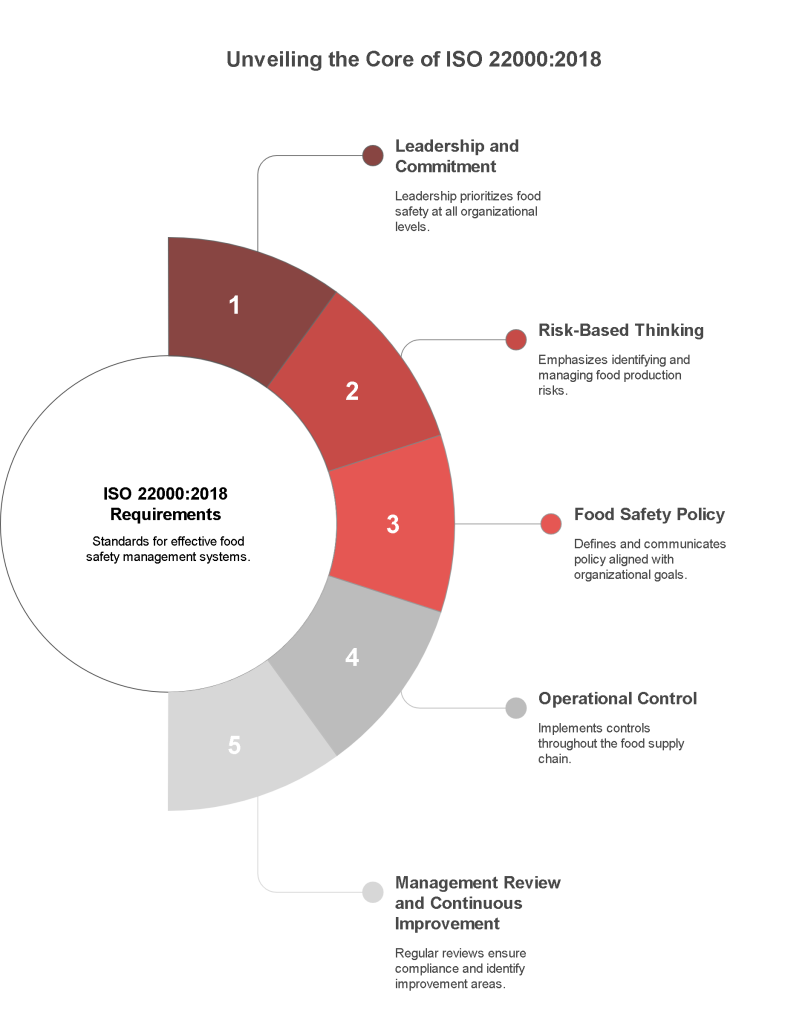
ISO 22000:2018 outlines several requirements that businesses must follow to maintain an effective food safety management system. These include:
1. Leadership and Commitment
One of the most significant changes in ISO 22000:2018 is the greater emphasis on leadership. Top management must actively participate in establishing, implementing, and maintaining the FSMS. This ensures that food safety is prioritized at all levels of the organization.
2. Risk-Based Thinking
The 2018 revision emphasizes the importance of risk management. Organizations must identify potential risks in the food production process and implement controls to prevent, eliminate, or reduce these risks to acceptable levels.
3. Food Safety Policy
Every organization must define a food safety policy that is communicated and understood throughout the organization. This policy must be aligned with the organization's overall goals and objectives.
4. Operational Control
To ensure food safety is maintained, organizations must implement operational controls at every stage of the food chain, from sourcing ingredients to distribution. This includes processes like monitoring, testing, and validation.
5. Management Review and Continuous Improvement
Regular management reviews are essential for evaluating the effectiveness of the FSMS. These reviews help organizations identify areas for improvement, track performance, and ensure compliance with the food safety policy.
ISO 22000:2018 and the Food Safety Chain
ISO 22000:2018 focuses on the entire food safety chain, from farm to table. It acknowledges that food safety is not solely the responsibility of individual organizations but requires cooperation and coordination across the entire food production and supply chain. This holistic approach ensures that food safety is addressed at every step, reducing risks and improving product quality.
Benefits of ISO 22000 Certification for UAE Food Businesses
Enhancing Food Safety and Quality
Certification ensures your products meet the highest safety standards, reducing contamination risks.
Meeting Regulatory Requirements
ISO 22000 aligns with UAE food safety laws and regulations, easing compliance.
Building Consumer Trust and Brand Reputation
Certified businesses gain a competitive edge by demonstrating commitment to food safety.
Expanding Market Access
ISO 22000 certification opens doors to new local and international markets, including exports.
Challenges of Implementing ISO 22000:2018
While the benefits are clear, implementing ISO 22000:2018 can be challenging. Some common challenges include:
Ongoing Maintenance: Maintaining compliance with ISO 22000:2018 requires continuous effort and resources, including regular training, monitoring, and audits.
Cost of Implementation: Initial setup costs, including training, audits, and documentation, can be significant for small businesses.
Resistance to Change: Employees and management may resist new processes or changes to existing procedures.
ISO 22000:2018 vs Other Food Safety Standards
There are several other food safety standards, such as HACCP (Hazard Analysis and Critical Control Points) and BRCGS (British Retail Consortium Global Standards), but ISO 22000:2018 stands out because of its holistic approach to the entire food safety management system. While other standards focus on specific aspects of food safety, ISO 22000:2018 integrates all aspects, from risk management to operational controls, into a unified framework.
ISO 22000:2018 is a comprehensive and globally recognized standard that helps organizations in the food industry manage food safety risks and ensure the safety of their products. By adopting this standard, businesses can not only comply with regulations but also build trust with consumers, improve their operational processes, and gain a competitive edge in the market.
At Universal Certification and Services (UCS), we provide ISO 22000:2018 certification to help organizations demonstrate their commitment to food safety and compliance with international standards.
Connect with UCS today to achieve globally recognized certification and strengthen your food safety management practices.
For more information please visit iso.org.
Can small businesses implement ISO 22000:2018?
What are the costs of ISO 22000:2018 certification?
Ready to Get ISO 22000:2018 Certification?
Contact our team today for a free assessment and tailored quote. Most eligible businesses can achieve certification within 7–10 days.