
ISO 29001:2020 — Petroleum, Petrochemical and Natural Gas Industries
Meet the quality management requirements of the oil and gas sector with ISO 29001:2020 certification in UAE.
In the demanding and safety-critical environment of the energy sector, precision and reliability are non-negotiable. That’s where ISO 29001:2020 comes in — a globally recognized standard designed specifically for the petroleum, petrochemical, and natural gas industries. It provides a sector-specific quality management system (QMS) framework that focuses on delivering consistent, high-quality products and services. Whether you're a manufacturer, contractor, or service provider, this standard ensures you’re aligned with industry best practices.
Understanding the Scope
ISO 29001 isn’t just for the big players. It’s designed for any product and service supply organization in the energy sector. From upstream drilling operations to downstream refining and distribution, this standard applies to companies of all sizes that want to manage risks and improve efficiency.
It covers:
• Equipment manufacturers
• Engineering firms
• Subcontractors and suppliers
• Organizations delivering solutions throughout the energy and petroleum lifecycle
The Evolution of ISO 29001:2020
Since its initial release in 2003, the standard has been refined through a series of updates to reflect evolving industry practices. The 2020 version aligns more closely with ISO 9001:2015, incorporating updated terminology, structure, and risk-based thinking. This refresh brings the standard in line with modern QMS practices.
Key updates in the 2020 edition include:
• Stronger integration with ISO 9001
• Enhanced focus on supply chain and contractor management
• Updated language around risk and opportunities
Key Objectives of ISO 29001:2020
So, why does ISO 29001 exist? Simple — to help organizations in the energy sector meet customer expectations and regulatory requirements, while improving efficiency and reducing risks.
Top goals include:
• Boosting customer satisfaction by delivering consistent, quality outputs
• Ensuring product reliability, especially in safety-critical environments
• Mitigating operational risks, including supplier-related failures
• Driving continuous improvement across operations
Relationship with ISO 9001
Think of ISO 29001 as ISO 9001 with a hard hat and steel-toe boots. It builds on the ISO 9001 framework but adds industry-specific requirements tailored for the oil and gas world.
Some overlaps:
• Process approach
• Customer focus
• Risk-based thinking
What’s different?
• Emphasis on traceability
• Strict control of outsourced processes
• Sector-specific terminology and documentation
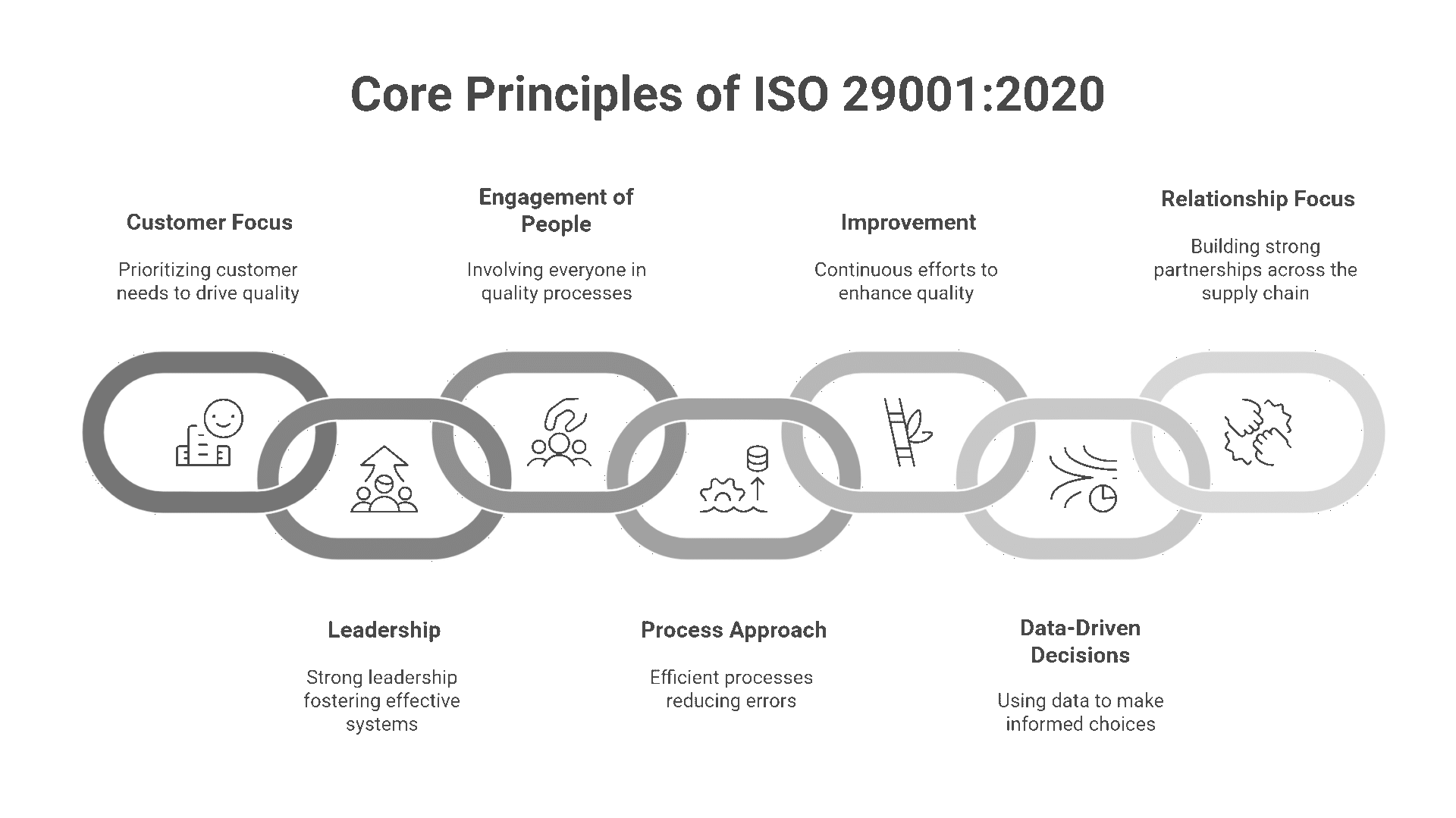
Core Principles of ISO 29001:2020
- The standard follows classic QMS principles but with a twist suited to high-risk industries.
- Customer focus: Quality starts with meeting customer needs.
- Leadership: Strong leadership equals strong systems.
- Engagement of people: Everyone plays a role in quality.
- Process approach: Efficient, repeatable processes = fewer errors.
- Improvement: Always aim to do better.
- Decisions driven by data: Rely on facts, not assumptions.
- Strong relationship focus: Build lasting partnerships, especially across your supply chain.
Main Clauses and Requirements
ISO 29001 follows a similar framework to ISO 9001:2015, built around seven fundamental sections:
- Context of the Organization
Understand your internal and external environment — what affects your operations? - Leadership
Management must take ownership of the QMS and communicate its importance. - Planning
Identify risks, set goals, and determine actions to achieve them. - Support
Ensure resources, competence, and documentation are in place. - Operation
Control the supply chain, manage nonconformities, and ensure traceability. - Performance Evaluation
Monitor, measure, and analyze performance. - Improvement
Take corrective actions and strive for continual progress.
Risk-Based Thinking in ISO 29001
This isn’t just about reacting to problems — it’s about preventing them in the first place.
• Identify potential risks (think: equipment failure, supplier non-compliance)
• Develop mitigation strategies
• Shift from reactive fixes to proactive prevention
Risk-based thinking ensures resilience even in volatile conditions.
Supply Chain Focus
The energy industry depends on intricate, globally interconnected supply networks.
• Supplier evaluations
• Contractor audits
• Traceability of materials and services
You’re only as strong as your weakest supplier — this standard helps you avoid costly surprises.
Case Studies
Example 1: Offshore Drilling Company
A major drilling firm slashed downtime by 22% after getting ISO 29001 and streamlining its supplier audits.
Conclusion
ISO 29001:2020 is more than just a quality standard — it’s a strategic weapon for the petroleum, petrochemical, and natural gas industries. It helps organizations build resilience, reduce risk, and deliver consistent quality in a world where even a small error can have massive consequences.
Whether you’re a startup in the supply chain or a multinational oil giant, adopting ISO 29001:2020 isn’t just smart — it’s essential. for more information please visit iso.org.
Ready to demonstrate your commitment to quality and risk control?
Get certified to ISO 29001:2020 with UCS — a trusted partner in accredited certification for the energy sector.
Request a certification quote now and take the first step toward safer, more reliable operations.
What is ISO 29001:2020 and who is it for?
What are the benefits of ISO 29001 certification?
Reduced operational and supplier-related risks
Enhanced supply chain visibility and control
Increased customer trust and competitive advantage
Alignment with global best practices in high-risk sectors
Is ISO 29001:2020 certification mandatory for oil and gas companies?
Why Get ISO 29001:2020 Certified?
Achieve international recognition and unlock new opportunities with UCS UAE.
Internationally Recognised
Your certificate is accepted by governments, clients, and global partners worldwide.
Fast Turnaround
UCS UAE delivers certification efficiently — typically within 7–10 business days from Stage 2 audit completion.
Win More Contracts
Many UAE government tenders and corporate procurement processes require ISO certification as a mandatory pre-qualification.
Expert Auditors
Our qualified, experienced auditors bring deep industry knowledge to every certification engagement.
Full Support
We guide you through every step — from application to certificate issuance and ongoing surveillance.
Trusted Certification Body
UCS is an internationally recognized certification body operating across UAE and GCC.
Ready to Get ISO 29001:2020 Certification?
Get a free assessment and tailored quote within 3–4 hours. No obligation.